

Key substrate in cover glass(CG) in display modules
Aug 12, 2026
In a complete assembled display module, the cover glass stands at the topmost layer. The primary role is to protect the display panel underneath. Except protection, it also servers an aesthetic function: Applying screen printed ink in various colors, OEM can achieve distint visual effects to enhance the overall appearance and finish of the module.
For this uppermost layer, it commonly referred to be cover glass(or short for CG), can be made from a range of materials including PC, PMMA and glass.
Nowaday, the small to medium sized displays with glass based cover lens already agined widespread adoption and represent the dominant solution in market.
For this article, we will take a closer look at the funamental material composition for the glass cover lenses.
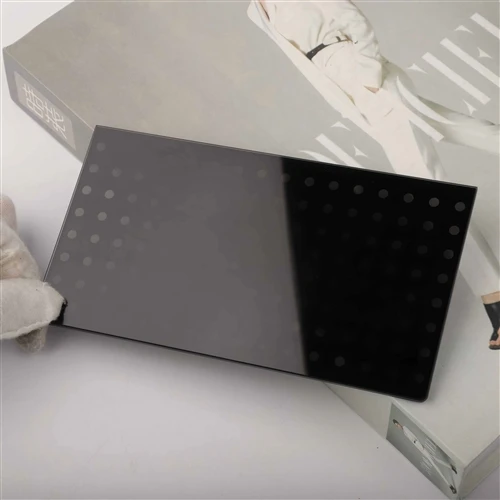
The core raw materials in glass cover lenses
The primary raw materials used in manufacturing glass cover lenses including:
Silicon dioxide (SiO₂)
Aluminum oxide (Al₂O₃)
Calcium oxide (CaO)
Sodium oxide (Na₂O)
Lithium oxide (Li₂O)
Potassium oxide (K₂O)
Magnesium oxide (MgO)
Among these, SiO₂, Al₂O₃, CaO, and Na₂O are the principal components, accounting for the largest share of the glass formulation. The resulting material is essentially a silicate glass, with SiO₂ forming the structural backbone, while alkali metal oxides are introduced to optimize melting behavior and tailor the glass physical properties.
Schematic of the Silicate Glass Network Structure
Each additive in the glass composition along with its respective proportion, influences a variety of performance attributes-mechanical, thermal, optical, chemical, and electrical. Moreover, these variables also affect manufacturing complexity, process flow, and production costs for glass suppliers.
Below, we break down the major constituents, their typical content ranges, and their functional roles, to offer a clearer picture of how glass cover lenses are engineered.
1. Silicon Dioxide (SiO₂)
As the primary former of the glass network, SiO₂ builds the fundamental skeletal structure through interconnected silicon–oxygen tetrahedra (SiO₄). It governs many essential physical and chemical characteristics including mechanical strength, chemical durability, thermal stability and surface hardness.
In soda-lime silicate glasses, SiO₂ content typically falls between 60% and 75%.
In aluminosilicate glasses, it ranges from about 52% to 63%.
2. Aluminum Oxide (Al₂O₃)
Adding Al₂O₃ to the glass matrix enhances chemical resistance and mechanical robustness, while also reducing the coefficient of thermal expansion.
Chemical stability:
Improves resistance to corrosive agents such as NaOH, HCl, NH₄F, and HF.
Mechanical strength:
Boosts compressive and tensile strength, yielding a more durable product.
Glass classification:
The Al₂O₃ level often defines the glass type: Low-alumina, medium-alumina, high-alumina or ultra-high-alumina silicate glass. Generally, higher Al₂O₃ content (within a practical range) correlates with better mechanical performance.
Thermal expansion:
Helps lower the thermal expansion coefficient, enhancing thermal shock resistance and ensuring dimensional stability during high-temperature chemical strengthening processes.
In medium-to low-alumina silicate glasses (often referred to as soda-lime types), Al₂O₃ content is typically around 5~13%. In high-alumina versions, it ranges from 13% to 24%.
3. Calcium Oxide (CaO)
The inclusion of CaO reduces melting temperature and viscosity, facilitating easier forming processes. It also reinforces chemical durability against solvent attack and contributes to improved mechanical strength.
In soda-lime glasses, CaO content is generally kept between 5% and 12%.
In aluminosilicate glasses, CaO levels tend to be lower: Usually 1~5% for two main reasons:
In high-precision optical applications, CaO must be minimized or omitted to avoid detrimental effects on optical properties.
Aluminosilicate glasses already benefit from high Al₂O₃ content, which provides adequate chemical and mechanical resilience, partially offsetting the need for CaO.
4. Sodium Oxide (Na₂O)
Na₂O plays a crucial role in chemical strengthening as a key participant in ion-exchange reactions. It also lowers melting points and viscosity, enabling fusion and shaping at relatively lower temperatures-improving processability for manufacturers.
Additionally, Na₂O influences optical properties like refractive index; adjusting its proportion allows fine tuning of the glass optical behavior for specific applications.
However, excessive Na₂O can undermine mechanical strength and thermal stability, so its concentration is carefully controlled.
In soda-lime glass, Na₂O levels typically range from 10% to 18%.
In aluminosilicate glasses, Na₂O content is usually kept lower, around 0–5%.
Other constituents such as lithium oxide (Li₂O), potassium oxide (K₂O), magnesium oxide (MgO), and boron oxide (B₂O₃) are also present in certain formulations.


