

Cover Glass strengthening: Chemically against Thermally Tempering
Aug 24, 2026
Why glass should be strengthened?
Untreated (annealed) glass is brittle. When it breaks, it shatters into sharp, dangerous shards. Strengthening glass serves a dual purpose: It makes the glass significantly harder to break and depending on the method, it alters the fracture pattern to reduce the risk of injury. Both methods achieve this by creating a state of compressive stress on the glass surface, which must be overcome before a crack can propagate.
What is Physical Tempering (Or Thermal Strengthening)?
Physical tempering is the traditional method of strengthening glass, often used for architectural windows and car side windows. It relies on a purely thermal process.
The Process:
The glass is slowly heated to a high temperature: Around 620°C to 700°C until it becomes soft. It is then rapidly cooled with high-pressure air or other cooling method. This rapid cooling causes the outer surface to solidify and contract faster than the hot interior. As the interior cools and contracts later, it pulls the rigid outer layer inward, creating strong surface compression balanced by tension in the core.
Advantages:
High Impact Resistance: It offers excellent structural strength against blunt force.
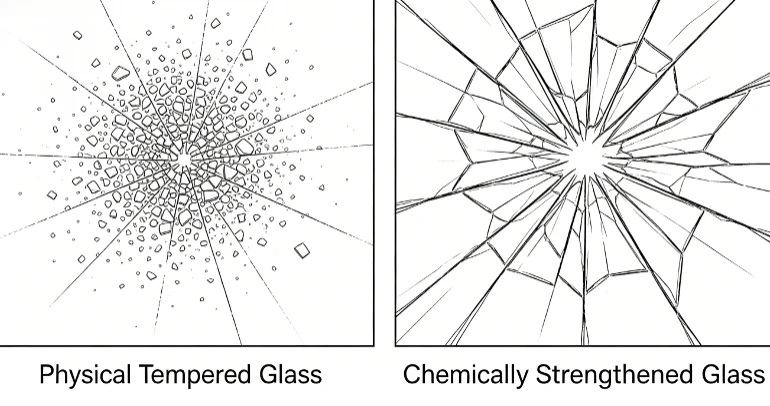
Safe Fracture Pattern: Upon breaking, physically tempered glass "dices" into small, relatively harmless, granular pieces rather than sharp shards.
Cost-Effective: The process is mature and relatively low-cost for suitable glass types.
Ideal for Thick Glass: Typically works best for glass that is 3mm thick or more.
Disadvantages:
Poor Optical Performance: The rapid cooling process creates a slight optical distortion, lowering optical clarity compared to chemical methods.
Post-Processing Impossible: The glass must be cut and shaped before tempering, as it cannot be machined afterward.
Thickness Limitation: The rapid cooling process struggles to create enough temperature differential in glass thinner than 3mm, leading to warping and weak compression.
What is Chemical Strengthening (Ion Exchange)?
Chemical strengthening is the dominant method used for smartphone screens, smartwatches and high end automotive displays.
The Process:
Instead of heat and air, chemical strengthening relies on ion exchange. The glass (typically an aluminosilicate glass rich in sodium ions) is immersed in a molten salt bath, usually potassium nitrate (KNO₃), at relatively low temperatures of around 300°C to 500°C. Here is where the magic happens: the smaller sodium ions (Na⁺) near the glass surface are displaced by the much larger potassium ions (K⁺) from the salt bath. Because the potassium ions take up more space, they jam together, creating a strong "crowded" layer of surface compression.
Advantages:
Ultra-Thin Capability: It works exceptionally well for thin cover glass, down to 0.5mm and even thinner.
Superior Optical Performance: The low-temperature process does not warp the glass, resulting in excellent optical flatness and clarity.
High Surface Hardness: The ion exchange creates a very high surface compressive stress, making the glass highly resistant to scratches.
Design Flexibility: The glass can be cut and shaped before the process, allowing for complex designs and precision holes.
Disadvantages:
Sharp Fractures: Unlike physical tempering, chemically strengthened glass does not "dice" easily. When it breaks, it tends to shatter into sharp flakes.
Batch Process: The ion exchange takes several hours to achieve sufficient depth, making it a slower, more costly process.
Cost: The process is generally more expensive than physical tempering for thick glass.
The Critical Differences
To clarify the decision-making process, here is a quick comparison based on key performance indicators:
| Feature | Physical Tempering | Chemical Strengthening |
|---|---|---|
| Optical Performance | ⭐⭐⭐ (Distortion possible) | ⭐⭐⭐⭐⭐ (Crystal clear) |
| Surface Smoothness | ⭐⭐⭐ | ⭐⭐⭐⭐⭐ |
| Thickness Range | > 3mm | 0.5mm – 3mm |
| Fracture Pattern | Granular (Safe) | Sharp flakes (Risky) |
| Impact Strength | Excellent (Structural) | Very High (Surface/Scratch) |
| Bending Strength | Lower | Higher |
| Post-Processing | Not Possible | Flexible (Pre-Process) |
| Cost | Lower | Higher |
When to Choose?
Choose Chemical Strengthening If:
Your cover glass thickness is 3mm or less (portable devices, wearables).
Scratch resistance and surface durability are a top priority.
You require complex shapes, precise edges, or very high optical clarity (touchscreen displays).
Choose Physical Tempering If:
You need maximum structural impact resistance for thicker glass (3mm+) .
Safety after breakage is a critical requirement, as it creates safe, granular chunks.
The device operates in harsh environments (industrial equipment, outdoor kiosks) where cost-effectiveness is a factor.


