

Can Aluminosilicate Thermally Tempering?
Aug 19, 2026
The direct answer: Technically yes, but nearly not in industry.
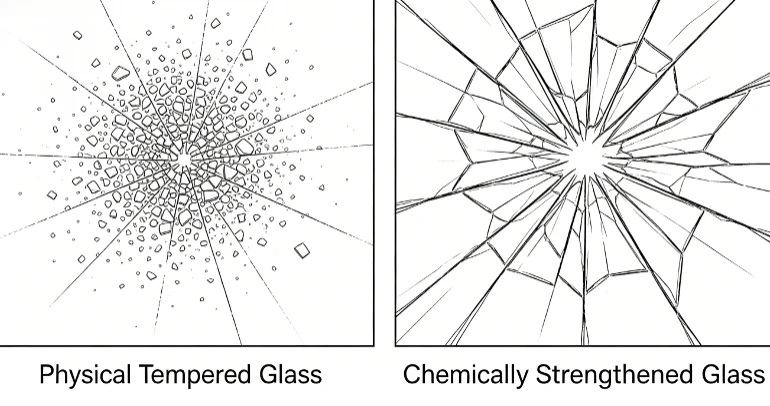
Why for that? The core reasons explain see below table:
| Aspect | Thermally tempering | Chemically Tempering(Mainstream) |
|---|---|---|
| Principle | Rapid quenching form Surface compressive stress | K⁺ ions replace Na⁺ ions to induce compressive stress on the surface |
| Suitable thickness | Normally ≥3mm | 0.1mm~ several mm |
| Depth of stress layer(DOL) | Deep(Around 1/5 of thickness) | Shallow(10-80μm, can be control) |
| Aluminosilicate Suitability | Poor | Excellent |
Why Aluminosilicate Glass Usually Not For Thermally Tempering?
1.Too thin: The aluminosilicate glass usually used in cover lens / screen protector with regular thickness 0.4~1.5mm. Thermal tempering needs enough thickness and temperature difference to create stress layer, thin substrate uneven stress layer after tempering, the bending is very serious.
2.Al₂O₃ is prepare for chemically strengthening: Alumina in high-alumina glass formulation serves to open the glass network structure, facilitating sufficient K⁺/Na⁺ ion exchange. It's the benefit for chemical tempering, yet offers no advantage for thermally tempering.
3.The performance of aluminosilicate glass become weaker after thermally tempering: Stress layer is deep but low surface compressive stress(Typically 80~150MPa) but after chemically strengthening, the surface compressive stress up to 700~900MPa, obvious advantage on drop / scratch resistance.
4.Transform can't be controlled: The soften point of Aluminosilicate glass is higher, the thermally tempering heat up temperature close to transform tempering, the flatness poor that couldn't meet cover glass optical requirements.
So what case thermal tempering can be considered?
1.Thickness ≥3mm Aluminosilicate glass.
2.Less requirements on heat resistance shock and scratch resistance.
3.No chemical strengthening technology and limit demand.
Conclusion:
The standard strenghtening method for Aluminosilicate Glass(Like Gorilla Glass, Dragon Tail, UTG etc). The thermally tempering can work but expensive and poor performance, which belongs to "Can be but not to be" technology.


