

Industrial touchscreen surface solutions: Customized cover glass
Jul 27, 2026
It's known that TFT LCDs belong to display devices: But to enable touch funtionality, they require an additional industrial touchscreen module bonded onto the display surface. What happens when customers want a unique visual design but cost prohibitive? The answer depends on customize the cover glass. As the most outer layer of a capacitive touchscreen, the cover glass is the most frequently customized component. Below we breakdown the key considerations for tailoring cover glass in industrial touchscreen applications.
First, Cover Glass Thickness Options

Correct cover glass thickness largely depends on the LCD panel size. Below table offers recommended baseline values:
| LCD Size | Cover Glass Thickness | Touch Module Thickness |
|---|---|---|
| 7.0" | 0.8mm | 1.4mm |
| 10.1" | 0.55mm | 1.4mm |
| 10.4" | 0.7mm | 1.4mm |
| 12.1" | 0.7mm | 1.4mm |
| 15" | 0.7mm | 1.8mm |
While these figures fit most standard design but non standard thicknesses like 0.55mm, 0.7mm, 1.0mm or 1.8mm are also feasible for the projects with special mechanical or optical requirements.
Second, optical Performance and True Color Rendition
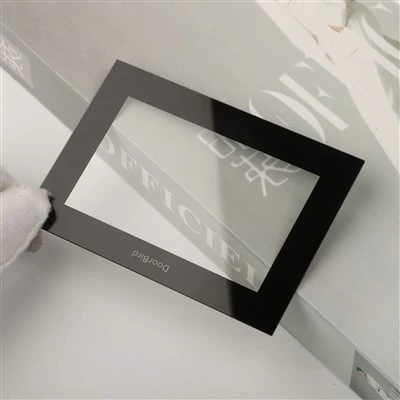
A piece of high quality TFT LCD delivers vibrant and crisp imagery. To preserve the visual fidelity after bonding, the cover glass must be optically clear and minimally reflective. We prefer to use ultra clear cover glass solutions specifically selected for industrial environments to guarantee color accuracy and brightness remain umcompromised.
Third, Safety and Mechanical Strength
In industrial settings, shatter resistance and impact safety are critical. Two widely adopted reinforcement methods are chemically strengthened glass and thermally toughened glass. Both processess significantly enhance structural integrity. When chemical strengthened glass breaks, it tends to fracture into long jagged shards: Distinct from the smaller, granulated fragments typical of thermally toughened glass. Every type offers a different failure mode and the choice, which depends on the application's specific safety and durability priorities.
Forth, Other Choice Materials for Cover Layers
Tough glass is the default material for cover lenses but alternatives exist. PMMA(polymethyl mathacrylate), a transparent thermoplastic is one of such option. It offers 3H hardness: Softer than glass and slightly lower optical clarity. Its lower dielectric constant also means to match the electrical performance of glass, PMMA must be roughly half of the thickness. Nonetheless, PMMA can be a practical and cost effective sustitute especially in rugged or weight sensitive industrial designs.

Fifth, Silkscreen Printing & Aethetic Customization
Since the cover glass sits at the very front of device, it naturally becomes a canvas for visual branding. By extending the glass beyond the active display area, we can create a flush, edge-to-edge surface. The resulting bezel offers space for black border printing or custom logos: Simple additions that dramatically elevate the overall appearance and brand identity of the industrial touchscreen.
For those curious about smartphone durability, drop-test comparisons often highlight how back cover materials: Vegan leather, plastic, glass, or ceramic affect impact resistance. As for display cover glass, most flagship phones perform similarly in drop tests, with notable exceptions like iPhone's Ceramic Shield and Huawei's Kunlun Glass standing out for enhanced toughness.


