
The Journey From Glass Substrate To Be Cover Lens
Aug 18, 2026
First. Main Composition of Mobile Device Glass
Glass is a non-crystalline inorganic solid material, ranking alongside metallic and organic materials as one in three fundamental material categories in nature. Inorganic materials mainly consist of metal oxides, carbides, nitrides and hydrides, with glass being the most widely applied type in consumer electronics.
Silicon dioxide serves as the primary component of standard glass. Featuring high hardness, brittleness and natural transparency, pure glass appears colorless. By adding different trace elements and chemical additives, OEM can produce glass in various hues including tea, dark gray and other custom colors to meet diverse design needs.

SECOND. Main Types & Commercial Grades of Electronic Glass
Glass is broadly categorized into non-oxide glass and oxide glass based on its chemical composition. Non-oxide glass has limited varieties and applications including chalcogenide glass and halide glass. Oxide glass, the dominant type for industrial and consumer use, covers silicate glass, borate glass, phosphate glass, and more subcategories.
According to the varying proportions of silica, alkali metals and alkaline earth metal oxides, oxide glass is further divided into quartz glass, high-silica glass, soda-lime glass, lead silicate glass, aluminosilicate glass, borosilicate glass and phosphate glass. For smart electronic devices, soda-lime glass and aluminosilicate glass are the two most commonly used cover glass substrates.
THIRD. Substrate Color Differences & Elemental Causes
Mobile glass displays subtle color variations when viewed from different angles, a phenomenon mainly caused by metal ions dispersed in its chemical composition. Ferric oxide (Fe₂O₃) is the most influential element in determining glass tint: the higher the Fe₂O₃ content, the deeper the green hue of the glass substrate.
Different grades of electronic glass feature strict iron ion content control, directly determining their light transmittance:
Regular soda-lime glass: Iron ion content ≈ 1000 ppm
Gorilla-grade high-performance glass: Iron ion content ≤ 250 ppm
Ultra-white TFT-LCD display glass: Iron ion content ≤ 150 ppm
Ultra-white glass boasts a light transmittance of over 92% and low ultraviolet transmittance, making it ideal for solar equipment and high-end TFT display industries. Beyond iron ions, other trace elements also shape glass color: nickel oxide creates purple tones under strong light, cobalt oxide produces dark brown shades at low concentrations, high potassium content renders pure blue, while sodium or boron elements form linear blue textures, copper oxide brings blue-green hues and chromium oxide delivers a vibrant ruby red color.
FORTH. Glass Strengthening Technologies & Performance Differences
The principle of chemical strengthened:
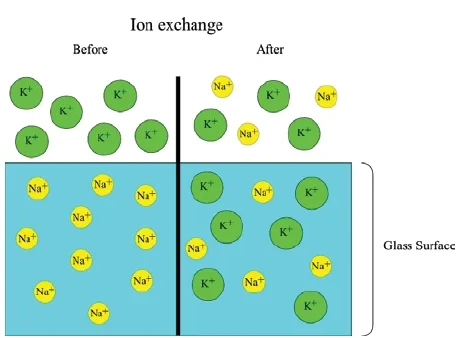
To enhance the durability of mobile cover glass, professional strengthening treatments applied to boost surface hardness, scratch resistance and impact resistance. There are two mainstream strengthening methods: physical tempering and chemical strengthening. For thin consumer electronic glass, chemical strengthening is the exclusive preferred process, thanks to its high efficiency, zero deformation after treatment and superior surface stress performance compared with physical tempering.
A noticeable performance gap exists between ordinary soda-lime glass and premium Gorilla glass even under identical chemical strengthening conditions. The ion exchange depth (DOL) of soda-lime glass only reaches 8μm, while Gorilla glass achieves up to 40μm. This massive difference stems from their distinct aluminum oxide (Al₂O₃) content.
Gorilla glass is a high-aluminum silicate material with an aluminum oxide content of 10%–15%, whereas ordinary soda-lime glass only contains 1%–2%. Aluminum oxide acts as an efficient active catalyst with a large specific surface area and high porosity. It greatly accelerates the ion exchange reaction between sodium ions and potassium ions during chemical strengthening, effectively shortening processing time, reducing production costs and improving overall glass toughness, scratch resistance and drop resistance. Its reinforcing effect is comparable to steel bars strengthening concrete structures.
FIFTH. Industry Challenges & Future Trends
Chemically strengthened glass offers excellent flexibility and impact resistance, and its manufacturing process has become highly mature. However, complex production procedures and high raw material costs keep its overall manufacturing expenses at a relatively high level. As a result, glass-like composite materials have emerged as cost-effective alternatives for mobile back covers, gradually occupying market share and bringing new competition to traditional glass cover solutions.


