

Chemically Strengthened Glass vs. Tempered Glass
Jul 14, 2026
In advanced glass engineering, 2 important methods stand out to enhancing the glass strength and safety: Chemical strengthening and thermal tempering. Both processes aim to induce surface compression to improve durability, the underlying mechanisms, applications and resulting material properties are fundamentally different.
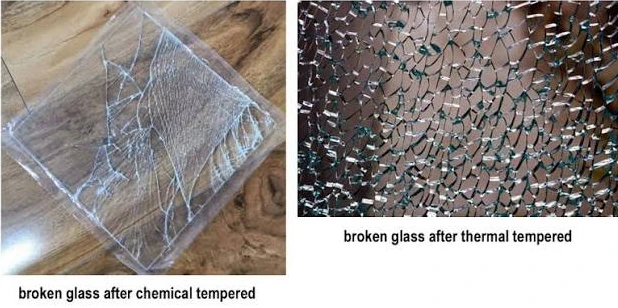
How can you identify difference between chemical strengthened and thermal tempered?
The Core Principle: Surface Compression
Both methods operate on a single principle: To place the glass surface into a state of residual compression. This compressive layer must be overcome by tensile forces before the glass can fracture, making it significantly stronger than annealed glass. The difference lies in how this compression is achieved.
Thermal Tempering (Toughened Glass)
Thermal tempering is a purely physical process that has been refined over centuries. It involves heating the glass to a high temperature, typically between 620°C and 700°C, near its softening point. The glass is then rapidly cooled using jets of forced air in a process known as quenching.
This rapid cooling causes the outer surface to solidify and contract faster than the hot interior. As the interior cools and contracts later, it pulls the already rigid surface into compression, leaving the core in a state of tension.
Key Characteristics of Tempered Glass:
Strength: Typically 4 to 5 times stronger than annealed glass.
Safety Breakage: When broken, it shatters into small, blunt, granular pieces rather than dangerous shards, making it a "safety glass".
Thickness Constraint: It is generally only effective for glass 3mm thick and above. The process becomes increasingly difficult and ineffective for thinner substrates.
Optical Distortion: The high-temperature process can introduce slight surface distortion or "roller waves" due to the softening of the glass.
Thermal Resistance: Offers high resistance to thermal stress due to the uniform compression layer.
Chemical Strengthening
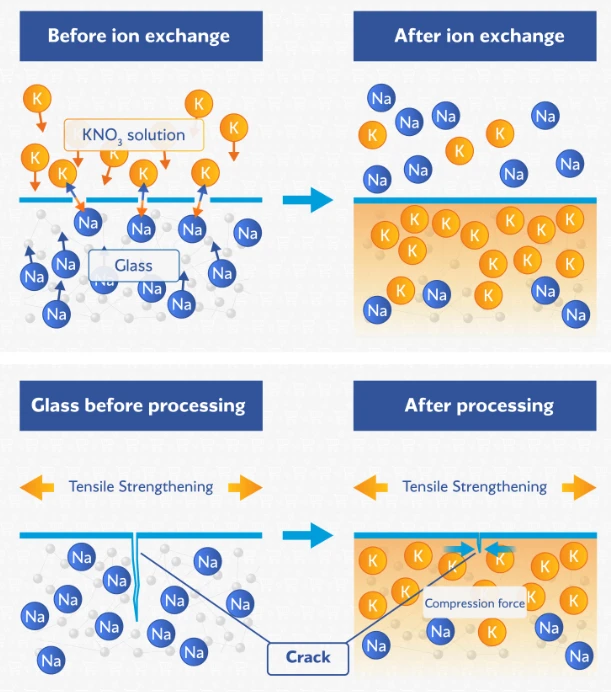
Chemical strengthening is a "cold" process that alters the glass at a molecular level. The glass is submerged in a molten salt bath, typically potassium nitrate (KNO₃), at a relatively low temperature of around 300°C to 500°C. This temperature is well below the glass transition point (Tg), preventing stress relaxation.
During this ion-exchange process, smaller sodium ions (Na⁺) near the glass surface are replaced by larger potassium ions (K⁺) from the salt bath. Because the larger ions take up more space, they "crowd" the surface, creating a highly compressed layer without deforming the glass shape.
Key Characteristics of Chemically Strengthened Glass:
Extreme Strength: Can achieve surface compressive stress of up to 1 GPa, surpassing thermal tempering. It is often 6 to 8 times stronger than float glass.
Thin Glass Capability: It is the ideal method for strengthening thin glass (< 3mm), with capabilities down to 0.3mm or even thinner, making it essential for portable electronics.
Optical Clarity: Maintains perfect optical flatness and surface smoothness, crucial for touchscreens and high-end displays.
Break Pattern: When broken, it tends to fracture into flakes or shards with sharp edges, unlike the safe dicing of tempered glass (unless laminated).
Process Time: The ion-exchange is a lengthy process, typically taking 8 to 16 hours, making it more expensive than thermal tempering. The compression layer is also very shallow (10-50 μm), meaning deep scratches can compromise the strength.
Comparison at a Glance
| Feature | Thermally Tempered Glass | Chemically Strengthened Glass |
|---|---|---|
| Core Process | Thermal (Heating and rapid cooling). | Chemical (Ion-exchange in molten salt). |
| Ideal Thickness | > 3.0 mm. | < 3.0 mm (works well down to 0.3 mm). |
| Surface Compression | High (~69 MPa+). | Ultra-High (Up to 1 GPa). |
| Optical Distortion | Minor distortion possible. | Excellent flatness and clarity. |
| Breakage Pattern | Small, blunt, safe granules. | Sharp-edged flakes (safety relies on lamination). |
| Common Applications | Car windows, building doors, shower screens. | Smartphone screens, tablets, avionics displays. |
Conclusion
The choice between chemically strengthened and thermally tempered glass is dictated by the application's specific demands. Thermal tempering remains the cost-effective and industry-standard solution for thick glass where safety (safe breakage) and thermal resistance are paramount, such as in architecture and automotive glazing.
Chemical strengthening is the premium choice for high-performance, thin glass applications. Its unparalleled strength, combined with superior optical quality, makes it indispensable for the modern electronics industry, despite its higher cost and different breakage characteristics. Emerging technologies are also beginning to blur the lines, with novel methods aiming to combine the speed of thermal processes with the strength of chemical methods.


